English Setter Dog
A Silhouette That Speaks Before the First Stitch
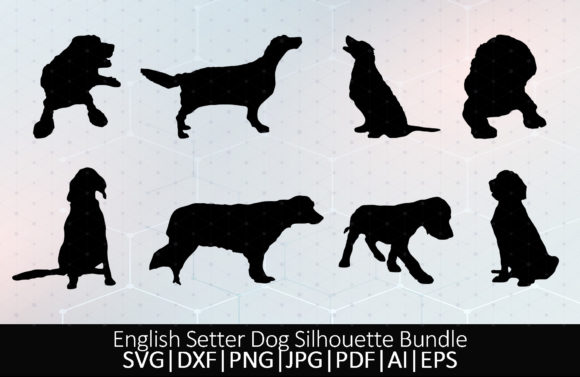
When I opened the English Setter Dog silhouette bundle, my first thought wasn’t “Oh, a dog graphic”—it was “This has presence.” Clean lines, confident posture, and that unmistakable setter stance—head lifted, tail gently curved, ears softly falling—give it quiet authority. It’s not cartoonish or overly stylized; it’s a respectful, balanced silhouette with just enough contour to read as English Setter at a glance, yet simple enough to translate beautifully in thread. As an embroidery designer who’s stitched hundreds of animal motifs for baby onesies, boutique aprons, and custom sweatshirts, I immediately pictured it on a natural linen tea towel—minimal, warm, and quietly meaningful.
Where This Design Earns Its Keep (and Why Clients Love It)
I recently used English Setter Dog for a small-batch run of embroidered canvas tote bags for a local dog rescue’s holiday fundraiser. The design scaled cleanly from 3.5” to 5.25” without losing definition—no jagged edges, no collapsed curves. On medium-weight cotton canvas, it stitched out crisply using a standard fill stitch with moderate density. No floating threads, no puckering. Customers responded instantly: “That’s *exactly* how my girl stands,” one wrote. That emotional resonance matters—especially for personalized gifts, nursery decor, or wedding favors where sentiment drives purchase. It works equally well as a subtle chest embroidery on a unisex crewneck or centered on a pillow cover for a country-chic bedroom. For Etsy sellers, this is the kind of digital embroidery file that converts: recognizable but not generic, detailed but not fussy, timeless but not stiff.
Real-World Embroidery Considerations You Can’t Skip
While English Setter Dog is highly adaptable, it’s not universally forgiving—and that’s okay. Here’s where attention pays off:
- Small hoop sizes & tight curves: Avoid stitching it smaller than 2.75” on a baseball cap. The ear tips and tail tip lose clarity below that, especially on curved surfaces where fabric tension shifts mid-stitch.
- Textured or stretchy fabrics: On terry cloth towels or lightweight jersey tees, use cutaway stabilizer—not tear-away. The silhouette’s clean outline relies on stability; without it, the bottom curve of the body can distort.
- Dark or dense fabrics: Test thread color contrast early. A single-tone satin stitch looks elegant on light fabric—but on navy twill or charcoal fleece, go for matte poly or rayon thread with slight sheen to lift the shape. Black-on-black? Not recommended unless you add a subtle running-stitch border.
- Frequent-wash items: Baby onesies and kitchen towels demand durability. Confirm stitch density isn’t too low—sparse fills can snag over time. If your machine allows, slightly increase underlay stitches for hold.
What It Adds to Your Finished Product—Beyond the Stitch
This isn’t just about legibility—it’s about perceived value. A well-executed English Setter Dog elevates handmade product credibility. On a hand-stitched patch or embroidered apron sold at a craft fair, it signals care and intention—not just “a dog logo slapped on.” For small shop owners, it reinforces brand consistency when used across multiple touchpoints: packaging stickers, social media banners, and physical merchandise all feel like part of the same thoughtful world. And for customers buying personalized gifts? That silhouette becomes a quiet signature—recognizable, warm, and confidently canine. It doesn’t shout. It belongs.
Practical Designer Notes Before You Hoop Up
Before committing to a client order or bulk production:
- Test the English Setter Dog embroidery file on scrap fabric matching your final substrate—same weight, same stretch, same dye lot if possible.
- Check thread color contrast in both daylight and indoor lighting. What reads clearly on screen may vanish on dark fabric.
- Review stitch density in your editing software—if it’s adjustable, avoid extremes. Moderate density balances durability and drape.
- Confirm hoop size compatibility. Some versions of this silhouette may include multiple sizes; choose the one that fits your smallest intended hoop without scaling down.
- Inspect corners and fine points (ear tips, nose, tail end) at 200% zoom. Are they sharp or rounded? Adjust jump stitches if needed to prevent thread nests.
- Run black-and-white mockups. Does the shape hold up without color cues? It should.
- Use proper stabilizer for your fabric type—especially important for commercial embroidery where consistency across dozens of pieces is non-negotiable.
- Verify licensing terms before selling finished items or bundling English Setter Dog into your own digital embroidery file packs. Since it’s labeled for Crafts and Graphics use, confirm whether resale of physical products is permitted—and whether attribution is required.
Final Thought: A Design That Fits Like a Well-Worn Glove
English Setter Dog isn’t flashy—but it’s reliable, expressive, and quietly versatile. It fits naturally into custom apparel, holiday embroidery, baby embroidery, and small business merchandise without demanding special treatment. It doesn’t ask for glitter or gradients to shine. It asks for good fabric, smart stabilizing, and the confidence to let its clean form speak for itself. Whether you’re an Etsy seller building a loyal following, a craft fair vendor curating seasonal stock, or a designer stitching heartfelt gifts for real people and their real dogs—this silhouette earns its place in your embroidery project queue. Just remember: test, observe, and trust your eye. Because in embroidery, the best designs don’t just look right on screen—they feel right when stitched, worn, gifted, and lived with.