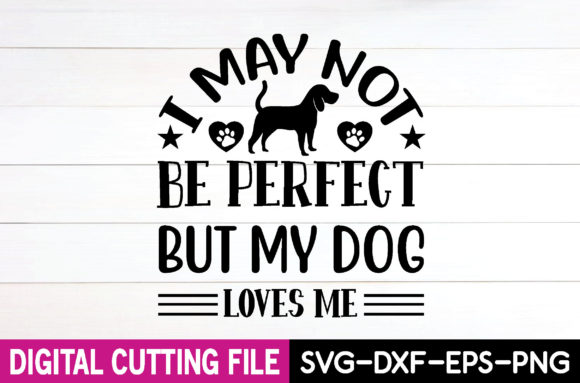
I May Not Be Perfect but My Dog Loves M
A Designer’s First Look: Warm, Worn-In, and Wonderfully Human
When I opened the ZIP folder for I May Not Be Perfect but My Dog Loves M, what struck me first wasn’t technical precision—it was tone. The hand-lettered style feels gently imperfect, like something scrawled in chalk on a sidewalk or stitched with quiet affection by someone who knows love doesn’t need polish. It’s not flashy or ornate; it’s grounded, approachable, and emotionally resonant. That matters—especially when you’re choosing a machine embroidery design to stitch onto a real product people will hold, wear, and gift.
Real-World Test: A Custom Embroidered Tote for a Local Dog Rescue Pop-Up
Last week, I prepped this design for a limited-run tote bag series supporting a neighborhood rescue. We used medium-weight canvas, tear-away stabilizer, and matte cotton thread. The phrase sat cleanly centered on the front panel—no crowding, no awkward spacing—and the “M” at the end gave just enough visual pause without feeling abrupt. Customers responded instantly: smiles, nods, even a few “That’s *so* me” comments while waiting in line. That kind of emotional shorthand is rare in Crafts-grade Graphics—and valuable for any Etsy seller or small shop owner building connection through handmade product.
Where It Shines (and Where It Asks for Thought)
I May Not Be Perfect but My Dog Loves M works beautifully on stable, medium-to-heavy fabrics: sweatshirt embroidery, tea towels, pillow covers, aprons, and structured tote bags. Its clean letterforms translate well into satin stitch outlines and balanced fill stitch areas—no dense nesting or over-stitching that could cause puckering or stiffness. On baby embroidery? Yes—but only on items like nursery wall hangings or soft cotton blankets where gentle stitch density won’t irritate sensitive skin.
It’s less ideal for tight hoop sizes under 4” diameter—those subtle curves in the lowercase “e” and “o” need breathing room. Avoid stretching it onto curved surfaces like caps unless you’re confident in your digitizing software’s ability to warp text cleanly. And while the PNG file gives you a crisp 300 dpi preview for printable mockups, remember: screen clarity ≠ stitch clarity. Always test the embroidery file on scrap fabric first—especially if you’re planning holiday embroidery runs or boutique branding with consistent color palettes.
Stitching Clarity Meets Emotional Resonance
This isn’t just about legibility—it’s about how the finished product lands. When stitched with warm neutrals (oatmeal thread on charcoal canvas, for example), I May Not Be Perfect but My Dog Loves M reads as comforting, not casual. That nuance elevates perceived value. Buyers don’t just see a phrase—they recognize themselves. That builds trust faster than any polished logo ever could. For craft business owners, that translates directly to repeat customers, heartfelt tags on social media, and word-of-mouth referrals rooted in authenticity—not algorithmic appeal.
Practical Notes Every Embroidery Designer Should Keep Handy
- Test before you commit: Run a sample on the exact fabric + stabilizer combo you’ll use for your custom apparel or embroidered patch. Thread tension shifts dramatically between cotton twill and brushed poly-blend.
- Check contrast early: Try black and white thread options against both light and dark backgrounds. The design’s open letter spacing helps readability—but thin strokes can vanish on busy textures or low-contrast fabric.
- Respect the details: The slight taper on the “M” and uneven baseline aren’t flaws—they’re intentional rhythm. Don’t auto-scale or force alignment unless you’re redesigning the entire aesthetic.
- Stabilizer choice matters: Use cutaway for stretchy fabric (like lightweight knits) and tear-away for stable weaves. Skipping proper stabilization risks distortion in the softer curves—especially around the “v” and “e.”
- Licensing check is non-negotiable: This is a digital embroidery file sold for personal and commercial use—but always confirm terms before bundling it into an Etsy listing, craft fair product, or wholesale offering.
Fabric & Fit: What Works, What Doesn’t
For personalized gifts and small shop merchandise, I May Not Be Perfect but My Dog Loves M thrives on natural fibers—cotton canvas, linen tea towels, organic cotton baby onesies. Its relaxed weight and modest height (roughly 3–4” wide at standard scale) make it ideal for left-chest placements on crewnecks or centered layouts on kitchen towels. It also layers gracefully beneath applique design elements—a tiny bone icon beside the “M,” for instance, adds charm without clutter.
Avoid using it on ultra-thin fabrics (like voile or rayon challis) without backing reinforcement, or on heavily textured surfaces (bouclé, thick terry cloth) where fine letterforms may blur. And skip dark fabric unless you’re pairing it with high-contrast thread—those soft edges need definition to read clearly after washing.
Why This Design Fits Real Creative Workflows
As someone who evaluates hundreds of embroidery files a year, I appreciate how I May Not Be Perfect but My Dog Loves M bridges practicality and personality. It’s not trying to be everything—it knows its lane: heartfelt, human-scaled, and quietly versatile. Whether you're an apparel decorator stitching holiday embroidery on fleece throws, a digital product seller building a curated bundle of Graphics for dog lovers, or a hobbyist making a one-off pillow cover for your best friend’s birthday, this design supports your intent instead of competing with it.
It doesn’t shout. It leans in. And in a market saturated with overdesigned, overproduced assets, that kind of quiet confidence is exactly what makes a handmade product feel like it was made *for* someone—not just *by* someone.
Final Thought: Design Is Feeling, Then Function
Before you download, resize, or stitch I May Not Be Perfect but My Dog Loves M, pause and ask: Does this match the voice of the person who’ll hold it? Will it still feel true after five washes? Does it leave room for their story—not just yours? When the answer is yes, you’re not just using a machine embroidery design. You’re extending an invitation—to joy, to recognition, to the kind of love that doesn’t need perfection to be complete.