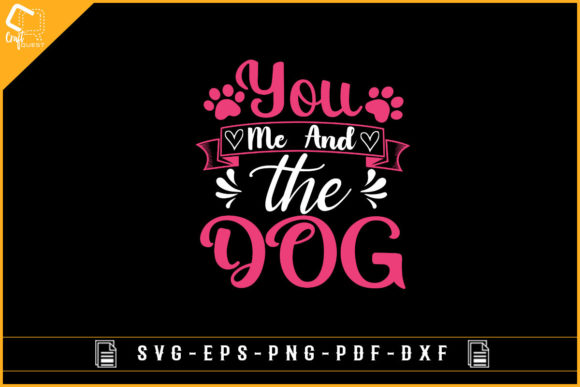
You Me and the Dog T-shirt Design
As someone who’s stitched over 300 custom embroidery projects—from boutique baby onesies to holiday market sweatshirts—I opened the You Me and the Dog T-shirt Design file expecting warmth, simplicity, and a quiet kind of charm. What I found was exactly that: a compact, centered composition with friendly lettering and a modest dog silhouette nestled between “You” and “Me.” It doesn’t shout. It smiles. And that matters—especially when you’re translating digital graphics into tactile, stitched reality.
Last week, I used it as the centerpiece for a linen-cotton blend tote bag destined for a local dog rescue’s volunteer appreciation day. No mockup, no filter—just me, my Brother Innov-is NQ3500D, and a 4x4 hoop. The design landed cleanly: legible at 3.2 inches wide, balanced in weight, and surprisingly adaptable across fabric types. That’s not guaranteed with text-heavy craft designs—and it’s why this one stands out in the Crafts category.
Where This Design Feels Like Home
The You Me and the Dog T-shirt Design isn’t built for maximalist statement sleeves or dense quilted jackets. It thrives where intimacy and intention meet: on the chest of a soft cotton crewneck, the front pocket of a denim apron, the lower corner of a baby blanket, or the curved brim of a structured cap. Its rhythm is gentle—not symmetrical, but harmonious. The dog outline is simple enough to stitch cleanly in satin stitch without fraying edges, and the lettering avoids tight kerning or ultra-thin serifs that vanish under fill stitch density.
I’ve seen similar phrases drown in poorly spaced vector files meant for vinyl cutting—not embroidery. But this one? It breathes. When digitized properly (and yes, it will need digitizing if you’re using it as a digital embroidery file), the curves hold up, the spacing stays generous, and the visual weight feels consistent across thread colors. On a light gray sweatshirt with navy thread? Crisp and grounded. On an oatmeal tea towel with ecru thread? Soft, warm, and quietly confident.
Real-World Embroidery Considerations
This isn’t just a pretty SVG—it’s a practical embroidery project waiting for thoughtful execution. Here’s what I watched for:
- Hoop size & placement: At its native scale, it fits comfortably in a 4x4 hoop—but test it first on scrap fabric. If you’re stitching on a curved surface like a cap, reduce scale slightly and reposition to avoid distortion near the seam.
- Fabric texture: Works beautifully on medium-weight cotton, fleece, and twill. Avoid using it full-size on very thin jersey or highly textured burlap without added stabilizer—those fine connecting strokes in the dog outline can get lost.
- Thread color contrast: The design relies on readability, not ornamentation. Dark thread on light fabric reads best—but if you’re stitching on dark fabric, use a high-contrast thread (e.g., white or cream) and consider adding a light underlay to lift the top stitches.
- Stitch density & detail: There are no micro-details or nested fills—no tiny eyes, no whiskers, no layered shadows. That’s a strength. It means fewer jump stitches, cleaner trims, and less risk of puckering on delicate baby embroidery or personalized gifts.
When to Pause—and Plan Ahead
This design shines in small-batch, handmade contexts—but it asks for intentionality. Don’t drop it onto a stretchy performance tee without testing stabilization first. Don’t assume it’ll hold up on a double-layered kitchen towel without adjusting stitch tension. And don’t forget: because it’s distributed as a Graphics asset (SVG/EPS/DXF/PNG/PDF), it’s not pre-digitized for machine embroidery. You’ll need to convert it—or hire a digitizer—to turn it into a true machine embroidery design.
For Etsy sellers and craft fair vendors: this is a strong candidate for curated bundles (“Dog Lover Collection”) or seasonal listings (“Personalized Holiday Tote Set”). But remember—your buyer isn’t buying pixels. They’re buying trust, clarity, and the feeling that their custom apparel or embroidered patch was made with care. That starts with how well the You Me and the Dog T-shirt Design translates from screen to stitch.
Design Notes You’ll Want to Keep Handy
Before stitching your first finished product, do these five things:
- Test the design on scrap fabric matching your final product’s weight and stretch.
- Check thread color contrast in both natural and artificial light—some creams shift yellow under bulbs.
- Review stitch density in your digitized version: aim for 8–12 stitches per mm in satin areas, and avoid overfilling the letterforms.
- Confirm your licensing allows commercial use—especially if you plan to sell finished items or resell the design as part of a craft business kit.
- Use cutaway or tear-away stabilizer appropriate for your fabric; lightweight mesh works well for t-shirts, while fusible adds security for baby embroidery or nursery decor.
Why It Earns a Spot in Your Design Assets
There’s a quiet power in designs that say something real without saying too much. The You Me and the Dog T-shirt Design does that. It supports storytelling—not shouting it. It invites personalization without demanding perfection. Whether you’re building a small shop product line, preparing holiday embroidery for family gifts, or sourcing reliable design assets for client work, this one delivers consistency, emotional resonance, and professional polish.
It won’t replace your go-to monogram or intricate floral motif—but it might become your favorite “human moment” design. The kind you reach for when someone says, “I want something that feels like home, not hype.”
And in today’s handmade landscape? That’s not just practical. It’s essential.