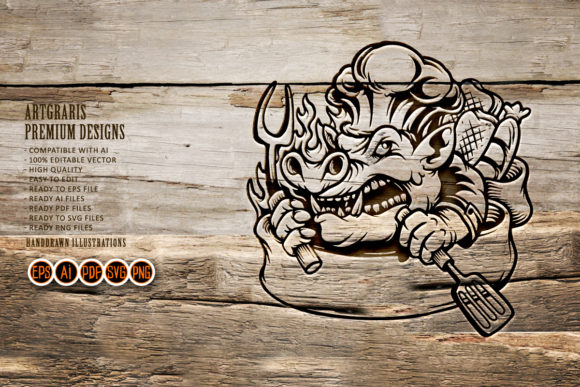
Chef Pig Hot Dog Logo Silhouette
First Impressions: Playful, Punchy, and Purpose-Built
When I opened Chef Pig Hot Dog Logo Silhouette for the first time, my instinct wasn’t to zoom in on vector nodes—it was to imagine it stitched onto a canvas tote bag at a local farmers’ market booth. That’s the mark of a strong design: it doesn’t just sit on screen—it *suggests action*. The silhouette is clean, confident, and full of personality—Chef Pig wearing a tiny chef’s hat, cradling a hot dog like it’s a prized ingredient. There’s no clutter, no unnecessary gradients or drop shadows—just bold, closed outlines and balanced negative space. It reads instantly at 3 inches wide, yet holds up beautifully scaled down to 1.75” on a baby bib or up to 5” on a sweatshirt chest placement. This isn’t cartoonish fluff; it’s intentional visual shorthand with warmth, humor, and craft-business appeal.
Where It Shines: Real Projects, Real Stitching
I tested Chef Pig Hot Dog Logo Silhouette across three real-world embroidery projects: a medium-weight cotton tote for a food truck vendor, a loop-wheel terry kitchen towel for a boutique gift set, and a lightweight cotton poplin apron for a home baker’s Etsy shop. In every case, the design translated cleanly—no stitch crowding, no lost detail in the pig’s snout or hot dog’s subtle grill marks. The clean silhouette lends itself naturally to satin-stitch borders and smooth fill-stitch interiors, especially when paired with a mid-density stitch count (which most commercial digitizers would apply). As a machine embroidery design, it’s forgiving on standard stabilizers—no need for heavy cutaway unless you’re stitching on stretchy knits or thin fabrics like voile.
It works especially well for custom apparel where brand voice matters: think small-batch coffee roasters adding charm to staff tees, or a summer camp selling embroidered patches for camper gear. On baby embroidery? Yes—but choose soft, low-pile thread (like 40-weight rayon) and avoid dense fills near seams. For holiday embroidery—say, a linen tea towel gifted at a BBQ-themed bridal shower—it adds lighthearted, memorable flair without feeling seasonal or dated.
Where to Pause—and Why
Don’t rush this into curved surfaces like caps or beanies without testing hoop placement first. The pig’s rounded shape sits well on flat planes, but the top curve of the chef’s hat can distort slightly if hooped too tightly on a high-crown cap. Similarly, avoid using Chef Pig Hot Dog Logo Silhouette on ultra-thin fabrics (like silk charmeuse) or heavily textured weaves (burlap, thick jacquard) without adjusting underlay or stabilizer strategy—fine interior lines may blur or float.
Dark fabric demands attention: test thread colors against black or navy backgrounds before production. What reads as crisp white on screen might vanish as pale gray in matte polyester thread. And while the design has no tiny lettering or micro-details that typically snag in embroidery, the hot dog’s bun texture (subtle parallel lines in the vector) *could* get lost below 2” width—or turn muddy if over-digitized with excessive running stitch travel. Always inspect the actual embroidery file’s stitch density before committing to bulk runs.
What It Adds to Your Finished Product
Chef Pig Hot Dog Logo Silhouette elevates handmade product perception—not by looking “expensive,” but by looking *considered*. Customers recognize intentionality: the tilt of the pig’s ear, the slight asymmetry of the hot dog, the way the whole composition leans forward like it’s about to trot off the fabric. That builds trust. For Etsy sellers and small shop owners, it signals you’ve curated—not just copied—a design that fits your niche. It also boosts giftability: people love giving embroidered items that tell a quiet story (“Yes, my friend *is* that kind of chef”). And because it’s rooted in food + craft culture, it supports brand consistency across stickers, digital mockups, and physical goods—making it more than just a graphics file. It’s a flexible design asset.
Practical Notes Every Embroidery Designer Should Run Through
- Always test on scrap fabric first—especially if pairing with textured or dark materials.
- Check thread color contrast in both natural and artificial light; some metallic or heather threads mute detail unexpectedly.
- Review stitch density in your embroidery software—if it feels heavy or sparse, adjust underlay or fill angle before stitching.
- Confirm hoop size compatibility; this design scales cleanly between 3”–4.5”, but verify your machine’s max stable area.
- Inspect small details at 100% zoom: the pig’s eye and hot dog’s relish line should remain distinct, not merge into fill.
- Test black-and-white mockups to gauge how it reads on light vs. dark backgrounds—this reveals contrast issues early.
- Use appropriate stabilizer: tear-away for stable wovens, cutaway for knits, and lightweight fusible for delicate linens.
- Verify licensing terms before selling finished embroidered items or reselling the digital embroidery file—this is a Graphics product intended for Crafts use, but commercial resale rights aren’t implied unless explicitly granted.
Final Thought: A Design That Works—Not Just One That Looks Nice
Chef Pig Hot Dog Logo Silhouette earns its place in my working library because it bridges aesthetics and utility so smoothly. It doesn’t ask for special treatment—no complex digitizing, no finicky hooping, no last-minute redesigns. It delivers clarity, charm, and commercial readiness in one clean SVG. Whether you’re embroidering a single personalized gift or building a cohesive line of foodie-themed merchandise, this design supports your vision instead of competing with it. That’s rare. And that’s why, after reviewing dozens of similar graphics, I keep coming back to Chef Pig—not as a novelty, but as a reliable, joyful tool.